
A primer on how markets will open on Monday, and why geopolitical risk may not be easily absorbed by financial markets this time around.
Geopolitics and events between Iran, the US and the wider Middle East will dominate financial markets on Monday. The situation has continued to escalate as we move through Sunday. Bombing has continued across the UAE and into Iraq, the US has confirmed the deaths of several US servicemen, and a US sanctioned oil tanker has been hit in Oman. In the aftermath of the death of the Ayatollah, Iran is now at a crossroads as we wait to see who the ruling establishment will pick to be its new leader.
New Iranian leader in focus
Several top regime figures who were killed in US air strikes on Saturday, which significantly narrows the field for potential new leaders. The process to choose a new Supreme Ruler is long and complex so a temporary council will handle duties until a new leader is elected. Experts are saying that the Iranian regime has been prepared for the Ayatollah’s assassination and will have a plan in place to deal with this exact scenario, thus a new leader could be in place in the coming days.
Is this conflict at its beginning stages?
For now, the temporary council have vowed revenge for the Ayatollah’s death, and Iran has scaled up their attacks today. Donald Trump has also posted on Truth Social and said that if Iran goes through with their threats to hit the US, then the US would ‘hit them with a force never seen before’. This suggests that Trump is not going to back down until he has annihilated or destroyed as much of the Iranian regime as possible. The President wants a surrender of the regime, and not a change of leader. This conflict could be at its beginning stages, and it may not get resolved as quickly as some had hoped last week.
The market reaction and scenario analysis
This context is important to understand the market reaction as we move into a new week. Geopolitical risks may not be as easily absorbed now that the US and Iran are at war, and the conflict has spread across the region. So, how will financial markets price this new and elevated geopolitical risk?
Oil: OPEC+ to the rescue
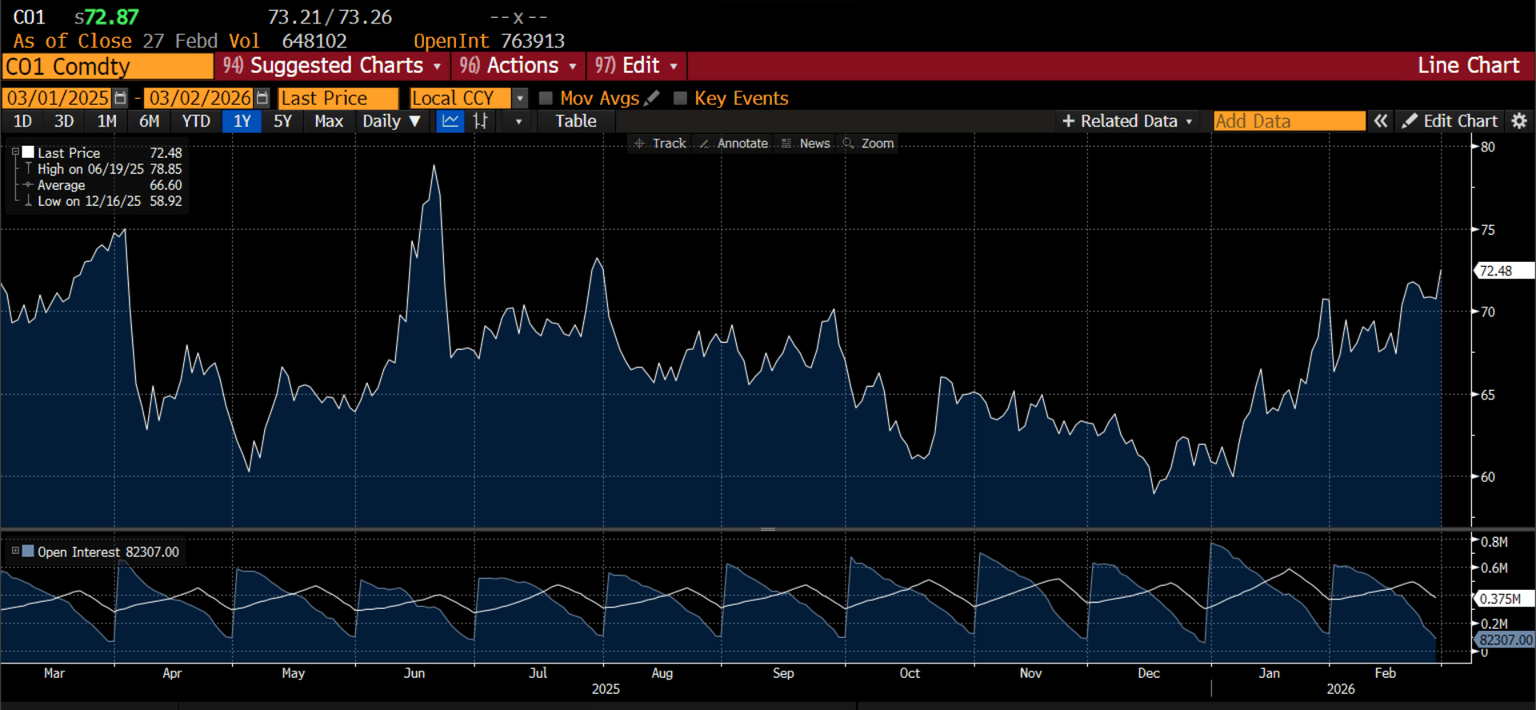
The main focus on Monday will be the oil price. The oil market will open late on Sunday, and although a conflict of this size in the Middle East should add upside pressure to the oil price, we think that gains could be limited on Monday, for two reasons: 1, Opec + announced plans to boost production by 206,000 barrels a day from next month, in reaction to this conflict. While this is a small increase, it is very symbolic that the world’s major oil producing nations and willing to react to the crisis and adjust supply to stop an oil price shock. 2, Iran’s foreign minister has confirmed that Iran has no plans to close the strait of Hormuz, a major route for global oil supplies.
These are positive developments that could see any upside in the oil price get capped initially at around $80 a barrel for Brent crude, and the crisis, for now, is unlikely to trigger $100 a barrel oil. It is also worth noting that the oil price has rallied into this crisis, and Brent crude is higher by nearly 8% in the past month as tensions have been building in the region. Thus, part of the conflict has been priced into the oil price already.
Iran not weaponizing the oil market, yet…
Although Iran could still use oil as leverage in this crisis, it looks like they are treading carefully at this stage, which could limit an oil price shock in the short term. This is a very fluid situation, and if Iran changes its tune around the Straits of Hormuz, or if any more oil tankers are attacked, there was a drone attack on a small tanker in Oman earlier on Sunday, then the price of oil could rise sharply.
Stocks and risky assets
The Abu Dhabi and Dubai stock markets are closed on Monday; however, the broader market will remain open. The stock market reaction could be shaped by the fact that this is a high stakes crisis that will not be resolved in a few days. If this is a prolonged crisis, this could stoke volatility and we expect stocks to fall and the Vix to rise.
FTSE 100 could be protected from a crisis sell off
The FTSE 100 was one of the top performing global indices last week, led higher by gains for miners, as they benefitted from the rise in the gold price. We expect the UK index to continue to outperform, and it could be in line to make fresh record highs as we move into March.
Air travel and hotels at risk from a sharp correction on Monday
Airlines and hotel groups could sell off sharply at the start of this week, as flights are grounded and air space remains closed in the Middle East. Holiday bookings over the lucrative Easter period may also start getting cancelled, after reports that Iran launched drones at UK military bases in Cyprus.
Any spike in the oil price could also reverberate through the equity market. However, if the oil price rise is fairly contained, as we expect, then downside could be limited, even though we expect global equities to start March in the red.
Europe outperformance over US set to continue
European equities should continue to outperform US indices, with the US tech sector being at risk from two factors as we move into the final month of the first quarter: the AI scare trade, and even greater concerns about AI spending in a period of heightened geopolitical risk. Europe has a strong mix of mining and materials stocks, big defence names and utilities, which may be in demand at the start of this week and could protect the region’s stock markets from the worst of the sell off.
There are two major risk events for investors this week: 1, If the Strait of Hormuz is closed by Iran, then the knock-on effect on global equities would be huge, as this could have major global economic ramifications. 2, if there are repeated air strikes in the region then tolerance for risk is likely to get worn down, and global stocks could sell off.
Safe havens: Dollar to be king in uncertain environment
The dollar has its troubles, and fears about de-dollarization and investors moving away from the greenback have been rife in 2026. However, in this deeply uncertain environment, we expect the dollar to be king. When FX markets open later Sunday, we expect the dollar to dominate the G10 FX space. There is no other currency that is as deep and liquid as the dollar, more than 50% of global trade is conducted in dollars, this rises to 90% for the trade of commodities.
Added to this, the US is a net exporter of oil and the world’s largest oil producer, pumping approximately 17,770,000 barrels per day last year. Thus, the US is a hedge against a global oil crisis and if the oil price rises, this will boost demand for both dollars and US oil.
Precious metals set to continue recovery
We would also expect precious metals to receive a boost, especially gold. As America has been amassing troops, planes and warships in the region in recent weeks, precious metals have been recovering after recent bouts of volatility. Gold and silver rose by 3.3% and 10.8% respectively last week, which easily outpaced gains for equities. We expect precious metals to continue to outperform as a store of value. Gold could be especially attractive, especially if the conflict triggers inflation from a surge in the oil price.
Sovereign bonds are also likely to see a fresh wave of inflows this week, as the market rotates out of riskier assets and into safe havens. If the conflict is extended in length, then the rising oil price will threaten price stability in the West, which could disrupt plans for future rate cuts from the BOE and the Federal Reserve. Thus, there could be a floor in how far bond yields fall if the oil price spikes for a prolonged period.
-1772392819842-1772392819844.png&w=1536&q=95)