

GBP/USD posts a positive note on Tuesday as market participants continued to sell the US Dollar (USD) and most US assets, following President Donald Trump’s trade-war escalation with Europe. This, along with a sell-off in Japanese bonds, keeps the CBOE Volatility Index (VIX) at yearly highs, a sign of risk aversion. At the time of writing, the pair trades at 1.3463, up 0.30%.
Sterling advances as trade-war fears and global bond turmoil drive Dollar selling and elevate risk aversion
Investors’ angst is at record highs after a Bloomberg headline read “Sudden Japan Bond Crash Unleashes Turmoil on Trading Floors.” The article mentioned that “concerns about Japan’s fiscal position, particularly Prime Minister Sanae Takaichi’s plans to cut taxes and boost spending, are raising doubts about the financial health of the government.”
This has pushed global bond yields higher, and the Greenback lower, amid an ongoing ‘sell America’ trade. The US Dollar Index (DXY), which tracks the performance of the buck’s value against six currencies, tumbles 0.53% to 98.50.
Data in the US revealed that the economy continues to create jobs, according to the ADP Employment Change 4-week average, which rose by 8,000, down from a week ago 11,750 people added to the workforce.
Across the pond, jobs data in Britain showed that the Unemployment Rate remained steady in the three months to November at 5.1%, above estimates for a 5% increase. Average Earnings excluding bonuses dipped from 4.6% to 4.5%, its weakest pace since April 2022.
After the data, money markets reaffirmed that the Bank of England (BoE) would hold rates unchanged at 3.75% at the February meeting. Nevertheless, traders are still seeing 41 basis points of easing towards the year’s end, according to Prime Market Terminal data.
In the meantime, the UK finance minister Rachel Reeves commented in Davos, Switzerland, that it is important to de-escalate the situation over Greenland, adding that “The future of Greenland is for the people of Greenland.”
GBP/USD Price Forecast: Technical outlook
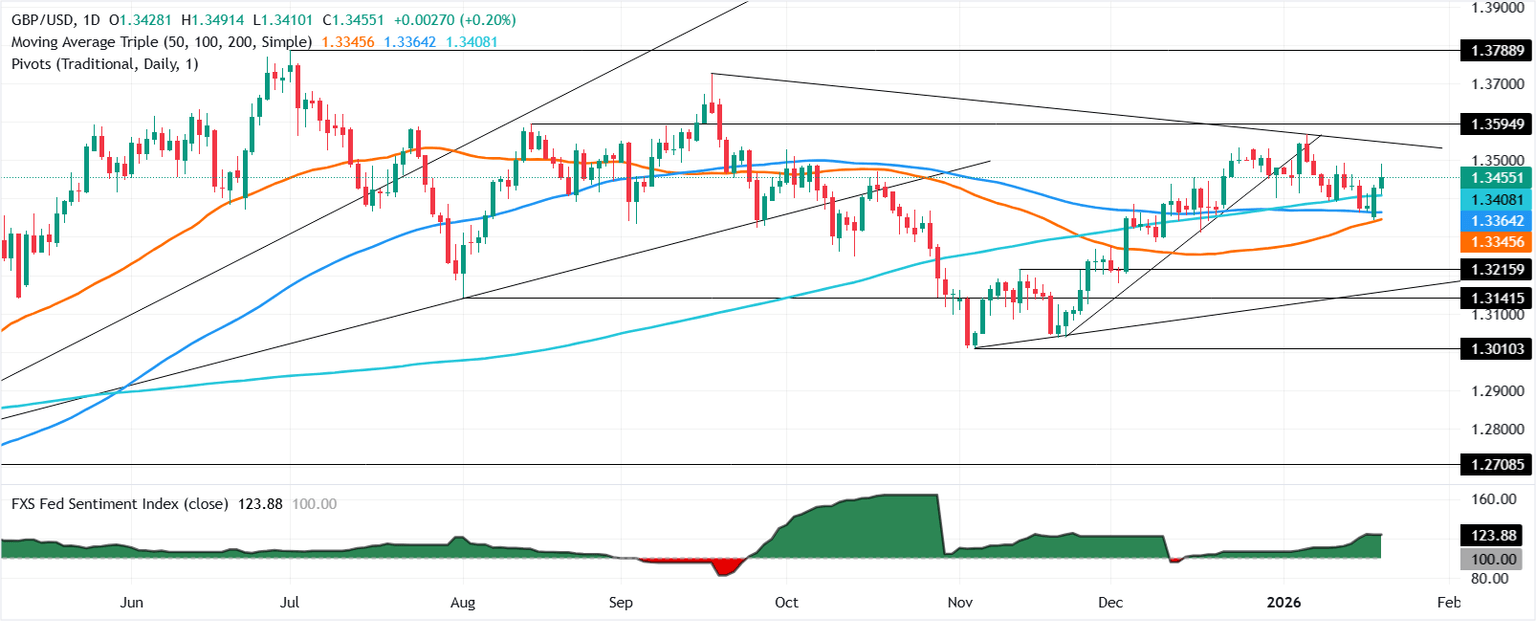
The technical picture shows that GBP/USD hit a one-week high of 1.3491 but seems poised to remain range-bound unless buyers reclaim a key support resistance level.
From a momentum standpoint, the Relative Strength Index (RSI) shows a shift in sentiment, turning bullish from the beginning of the week.
With that said, if GBP/USD climbs past 1.3500, traders could challenge a down-slope trendline at around 1.3550/75. Once broken, up next lies 1.3600, followed by the September 17 swing high at 1.3726.
Otherwise, if Cable stumbles below 1.3450, bears can challenge the 200-day SMA at 1.3402. On further weakness, bulls’ next line of defense would be the 50-day SMA at 1.3330.
Pound Sterling FAQs
The Pound Sterling (GBP) is the oldest currency in the world (886 AD) and the official currency of the United Kingdom. It is the fourth most traded unit for foreign exchange (FX) in the world, accounting for 12% of all transactions, averaging $630 billion a day, according to 2022 data.
Its key trading pairs are GBP/USD, also known as ‘Cable’, which accounts for 11% of FX, GBP/JPY, or the ‘Dragon’ as it is known by traders (3%), and EUR/GBP (2%). The Pound Sterling is issued by the Bank of England (BoE).
The single most important factor influencing the value of the Pound Sterling is monetary policy decided by the Bank of England. The BoE bases its decisions on whether it has achieved its primary goal of “price stability” – a steady inflation rate of around 2%. Its primary tool for achieving this is the adjustment of interest rates.
When inflation is too high, the BoE will try to rein it in by raising interest rates, making it more expensive for people and businesses to access credit. This is generally positive for GBP, as higher interest rates make the UK a more attractive place for global investors to park their money.
When inflation falls too low it is a sign economic growth is slowing. In this scenario, the BoE will consider lowering interest rates to cheapen credit so businesses will borrow more to invest in growth-generating projects.
Data releases gauge the health of the economy and can impact the value of the Pound Sterling. Indicators such as GDP, Manufacturing and Services PMIs, and employment can all influence the direction of the GBP.
A strong economy is good for Sterling. Not only does it attract more foreign investment but it may encourage the BoE to put up interest rates, which will directly strengthen GBP. Otherwise, if economic data is weak, the Pound Sterling is likely to fall.
Another significant data release for the Pound Sterling is the Trade Balance. This indicator measures the difference between what a country earns from its exports and what it spends on imports over a given period.
If a country produces highly sought-after exports, its currency will benefit purely from the extra demand created from foreign buyers seeking to purchase these goods. Therefore, a positive net Trade Balance strengthens a currency and vice versa for a negative balance.