
Gold price (XAU/USD) tumbles to a two-week low below $4,700 during the Asian trading hours on Monday, pressured by some profit-taking. The precious metal extends the decline after reaching historic highs last week amid signs of political stability in the United States (US) as Kevin Warsh was selected to be the next Fed chair, easing concerns over the US central bank’s independence.
On the other hand, ongoing geopolitical tensions, including US-Iran tensions, could underpin traditional safe-haven assets such as Gold. Traders will closely monitor the developments surrounding US-Iran negotiations, along with further clarity on Warsh’s policy direction. Additionally, rising demand from major central banks might contribute to the precious metal’s upside.
The US ISM Manufacturing Purchasing Managers Index (PMI) data will be released later on Monday. The figure is expected to improve to 48.3 in January from 47.9 in December. If the report shows surprise to the downside, this could drag the US Dollar (USD) lower and lift the USD-denominated commodity price, as a weaker USD makes greenback-priced gold more attractive for foreign buyers.
Daily Digest Market Movers: Gold remains under pressure after historic plunge
- Trump said over the weekend that the US will “hopefully” make a deal with Iran. Meanwhile, Iranian Supreme Leader Ayatollah Ali Khamenei warned that any attack on his country would spark a regional conflict, as the US continues to build up its forces nearby.
- “Investors and global central banks have… favored gold as their reserve currency of choice, which they believe insulates them from US policy dependence,” said Emma Wall, chief investment strategist at Hargreaves Lansdown. “Certain nations will have observed the threat of Russia having its US dollar assets seized by global players supportive of Ukraine, and subsequently considered the metal a more attractive neutral reserve,” she added.
- US President Donald Trump nominated Kevin Warsh to succeed Jerome Powell as the next Fed Chair. He is scheduled to take office in May 2026.
- The US Producer Price Index (PPI) climbed 3.0% year-over-year (YoY) in December, beating estimates of 2.7%, according to the Bureau of Labor Statistics on Friday. The PPI rose 0.5% month-over-month (MoM) in December, above the market consensus and the previous reading of 0.2%.
- Hotter-than-expected US producer price inflation could further strengthen the case for the Fed to hold rates steady while policymakers monitor how inflation trends.
- Markets see nearly an 87% chance of interest rates staying at the current 3.50%–3.75% range, with the first 25-basis-point (bps) reduction likely in June.
Gold keeps a bullish vibe in the longer term, but a neutral RSI warrants caution for bulls
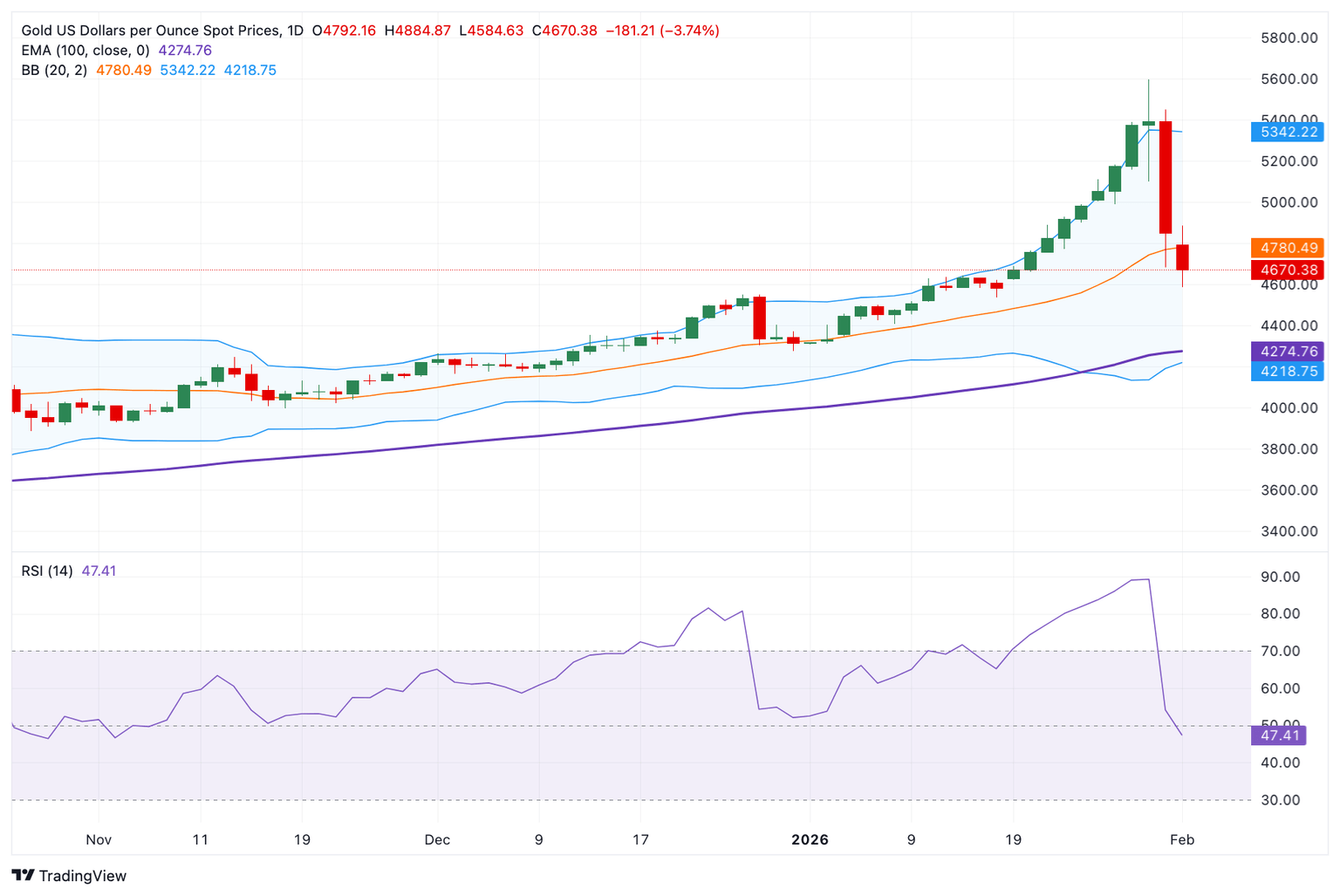
Gold trades in negative territory on the day. However, in the longer term, the path of least resistance is to the upside, as the yellow metal is well-supported above the key 100-day Exponential Moving Average (EMA) on the daily chart. The Bollinger Bands widen, suggesting a strong trend continuation.
Despite the bullish trend, the 14-day Relative Strength Index (RSI) hovers around the midline, indicating that further consolidation or a temporary sell-off cannot be ruled out.
Green candlesticks and sustained trading above the February 2 high of $4,885 could make another run toward the $5,000 psychological level. The next upside barrier to watch is the January 27 high of $5,182.
On the flip side, the first downside target for Gold is seen at the January 19 low of $4,620. Any follow-through selling below the mentioned level could expose the January 12 low of $4,513. The key contention level emerges at the 100-day EMA of $4,275.
Gold FAQs
Gold has played a key role in human’s history as it has been widely used as a store of value and medium of exchange. Currently, apart from its shine and usage for jewelry, the precious metal is widely seen as a safe-haven asset, meaning that it is considered a good investment during turbulent times. Gold is also widely seen as a hedge against inflation and against depreciating currencies as it doesn’t rely on any specific issuer or government.
Central banks are the biggest Gold holders. In their aim to support their currencies in turbulent times, central banks tend to diversify their reserves and buy Gold to improve the perceived strength of the economy and the currency. High Gold reserves can be a source of trust for a country’s solvency. Central banks added 1,136 tonnes of Gold worth around $70 billion to their reserves in 2022, according to data from the World Gold Council. This is the highest yearly purchase since records began. Central banks from emerging economies such as China, India and Turkey are quickly increasing their Gold reserves.
Gold has an inverse correlation with the US Dollar and US Treasuries, which are both major reserve and safe-haven assets. When the Dollar depreciates, Gold tends to rise, enabling investors and central banks to diversify their assets in turbulent times. Gold is also inversely correlated with risk assets. A rally in the stock market tends to weaken Gold price, while sell-offs in riskier markets tend to favor the precious metal.
The price can move due to a wide range of factors. Geopolitical instability or fears of a deep recession can quickly make Gold price escalate due to its safe-haven status. As a yield-less asset, Gold tends to rise with lower interest rates, while higher cost of money usually weighs down on the yellow metal. Still, most moves depend on how the US Dollar (USD) behaves as the asset is priced in dollars (XAU/USD). A strong Dollar tends to keep the price of Gold controlled, whereas a weaker Dollar is likely to push Gold prices up.