The USD is little changed as markets grow increasingly comfortable with developments in the Middle East. At the same time, attention is shifting toward a heavy slate of central bank decisions, highlighted by today’s Fed announcement.
As North American traders enter, the dollar is mixed against the major currency pairs, with price action—rather than direction—telling the story.
EURUSD is probing a key technical zone. The pair has attempted to extend above its 200-hour moving average at 1.1543 and is testing a swing area between 1.1542 and 1.1555. Sellers are leaning on the first test, with price oscillating around the moving average as traders decide whether this break can stick or fail.
USDJPY moved lower during the Asian and early European sessions, testing both the rising 200-hour moving average and an upward-sloping channel trendline. Although the price briefly dipped below both levels, it quickly rebounded. A sustained move below the 200-hour MA at 158.70 would be needed to tilt the bias more bearish. The pair currently trades near 159.02, with the next upside target at the flattening 100-hour MA at 159.19. Earlier this week, that level acted as support before breaking—making it a key pivot. A move back above would shift the bias more bullish.
GBPUSD remains range-bound, trading on either side of its 200-hour moving average at 1.3354. The lack of direction reflects broader market indecision. A push higher would target the 100-day moving average at 1.3395, followed by a retracement level near 1.3407. On the downside, a break below 1.3340 would open the door toward the 100-hour MA near 1.3314.
On the data front, US PPI will be released at 8:30 AM ET, with expectations of +0.3% month-over-month and +2.9% year-over-year. Core PPI (ex-food and energy) is also expected at +0.3% and +3.7% respectively.
The main event, however, is the FOMC decision at 2 PM ET. The Fed is widely expected to hold rates steady, but the backdrop is increasingly complex. Rising oil prices tied to the US-Iran conflict have added a new layer of inflation uncertainty, forcing markets to reassess the timing of future rate cuts.
While consensus is for a hold, the debate centers on whether the energy-driven inflation impulse is temporary or something more persistent. Statement changes and the dot plot are expected to show only modest adjustments, though inflation projections are likely to be revised higher.
Views on the rate path remain divided. Citi is the most dovish, looking for cuts as early as April amid concerns over slowing job growth. BofA expects easing in June and July, while Goldman Sachs sees cuts later in September and December. JP Morgan, on the other hand, does not expect any cuts in 2026.
Looking back at the Fed’s December 2025 projections provides useful context. The committee projected 2026 GDP growth at 2.3%, unemployment at 4.4%, headline PCE inflation at 2.4%, and core PCE at 2.5%. The federal funds rate was expected to average 3.4%, signaling a gradual easing path.
Today’s updated projections could reflect meaningful shifts.
-
Growth may be revised lower toward the 1.8%–2.0% range as higher energy prices weigh on consumption and business activity.
-
Unemployment could drift higher toward 4.5%–4.6% if labor market momentum slows.
-
Inflation is likely to be revised higher, with headline PCE potentially rising toward 2.6%–2.8%, while core inflation sees a more modest upward adjustment.
The policy rate projection remains the key variable. A stagflationary backdrop—slower growth alongside higher inflation—puts the Fed in a difficult position. Inflation argues for tighter policy, while growth risks argue for easing. The most likely outcome is a median rate near 3.4%, but with increased dispersion and uncertainty around that estimate.
All eyes will ultimately be on Powell’s press conference for guidance on how the Fed is balancing these competing risks.
In addition to the US interest rate decision, the Bank of Canada will also announce their rate decision at 9:45 AM ET. The expectation is for no change in policy at 2.25%.
The consensus for today’s Bank of Canada (BoC) announcement (Wednesday, March 18, 2026) is a unanimous expectation for a “Hold.” Markets and economists widely expect the Governing Council to maintain the overnight rate at 2.25%.
While the rate itself is expected to stay put, the “market” is actually looking for how the Bank balances two conflicting forces in its official statement.
1. The “Hawkish” Wildcards (Pressure to keep rates up)
-
The Oil Shock: Ongoing conflict in the Middle East and disruptions in the Strait of Hormuz have pushed oil prices significantly higher. The market wants to see if the BoC views this as a temporary “blip” or a structural threat that could reignite headline inflation.
-
Trade Uncertainty: With CUSMA (USMCA) renegotiations looming this summer and unpredictable U.S. trade policy, the Bank is expected to maintain a “cautious” stance, as these tensions typically lead to higher costs for goods.
2. The “Dovish” Reality (Pressure to potentially cut later)
-
Weak Domestic Data: Recent figures show the Canadian economy is cooling. February saw a loss of 84,000 jobs, pushing the unemployment rate up to 6.7%.
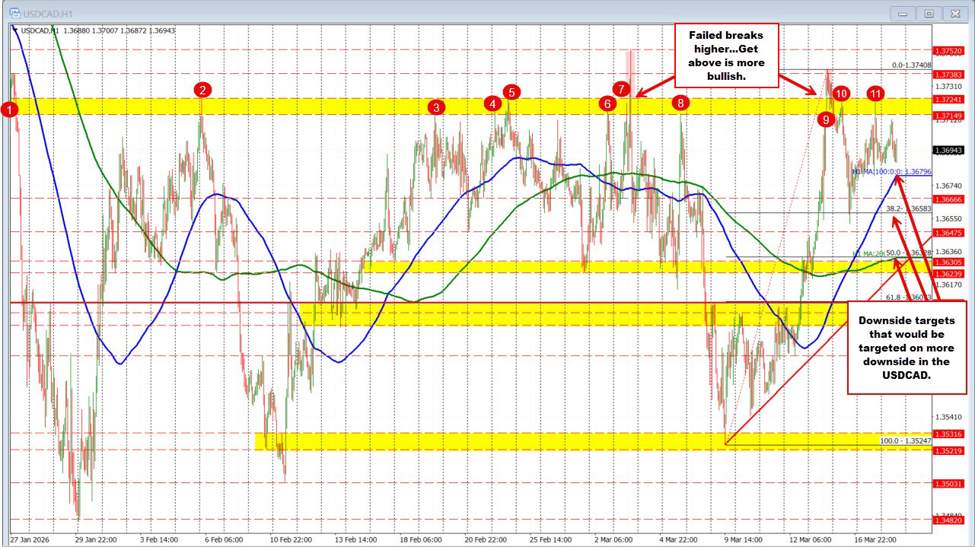
The USDCAD is trading up and down (little changed) ahead of the decision. The rising 100 hour MA is catching up to the price at 1.36796. The current price is at 1.3695. A move below would tilt the short term bias to the downside with the 38.2% of the move up from last week’s low at 1.3658 the next target. A move below that level would have traders looking toward the 50% and 200 hour MA at 1.36328. On the topside a sustained move above 1.3714 to 1.3724 swing area would be more bullish.