
Spot Liquidity Voids and Fair Value Gaps (FVG) Using AI Tools
Introduction
In modern forex trading, understanding how institutions move the market is the key to consistent profitability. Most retail traders rely on lagging indicators, while professionals focus on price delivery, liquidity, and imbalances.
Concepts like Fair Value Gaps (FVG) and Liquidity Voids, derived from ICT (Inner Circle Trader) and Smart Money Concepts (SMC), help traders identify high-probability setups.
With the rise of AI tools, traders can now automate analysis, detect patterns, and refine entries with precision.
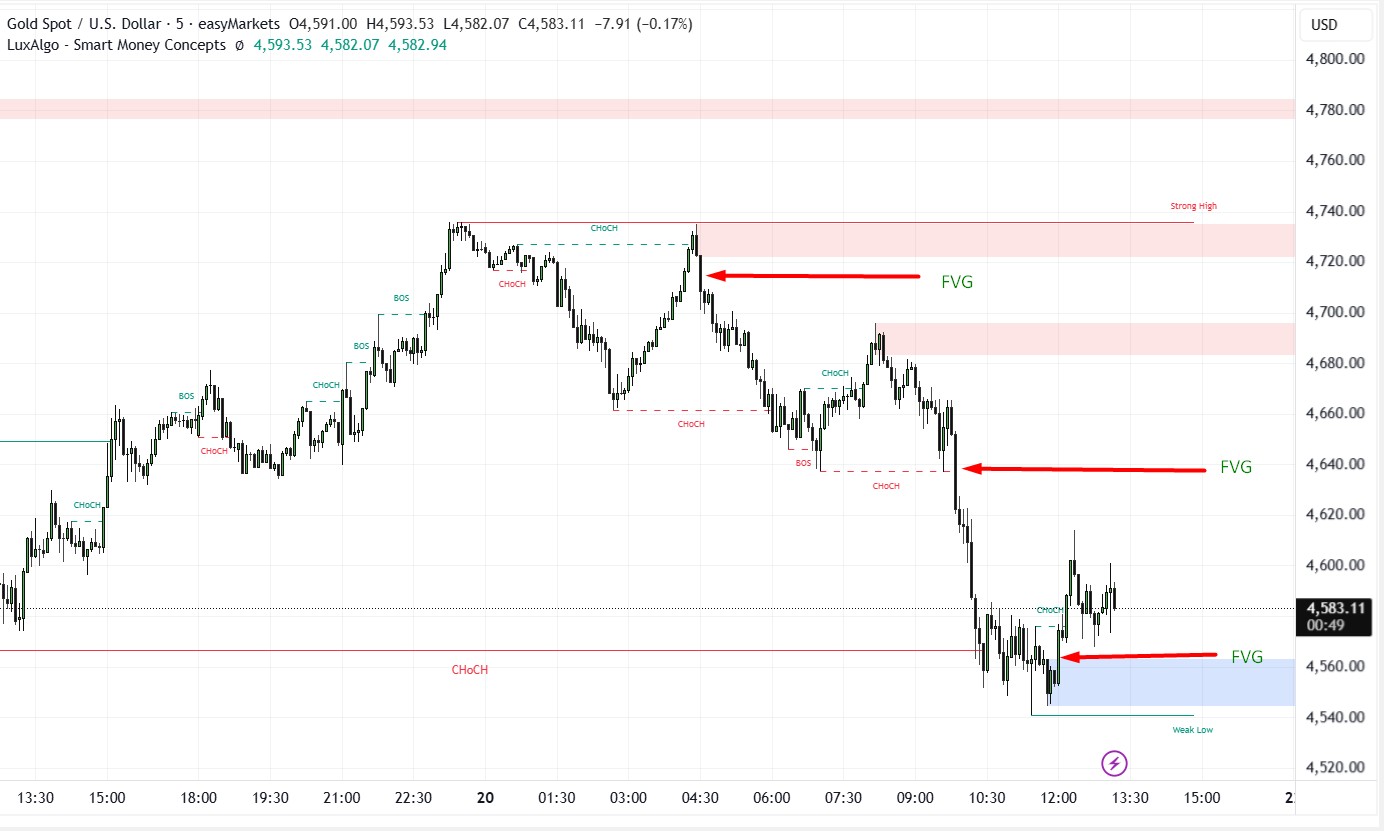
What is Fair Value Gap (FVG)?
A Fair Value Gap (FVG) is a price imbalance that forms when the market moves aggressively, leaving a gap between candles with little trading activity.
Structure of an FVG
An FVG forms across three candles:
- First candle: Normal movement
- Second candle: Strong displacement
- Third candle: Continuation
The gap exists between:
- High of the first candle
- Low of the third candle (bullish case)
Why Fair Value Gaps Matter
FVGs represent inefficiencies in price, meaning price often returns to fill them.
👉 This explains why gaps get filled in trading — markets seek balance.
What is Liquidity Void?
A Liquidity Void is a large imbalance created by a strong, fast price move with minimal trading activity.
Key Characteristics
- Explosive price movement
- Thin trading zones
- Little to no retracement
Liquidity Void vs Fair Value Gap
| Feature | Fair Value Gap | Liquidity Void |
|---|---|---|
| Size | Small | Large |
| Structure | 3 candles | Multiple candles |
| Precision | High | Medium |
| Purpose | Entry zone | Directional bias |
👉 In simple terms:
FVG = precise entry
Liquidity Void = broader imbalance
ICT Imbalance Explained
In ICT trading, imbalances occur when price moves too quickly, leaving inefficient areas.
Types of Imbalances
- Fair Value Gaps (FVG)
- Liquidity Voids
- Volume Imbalances
Why Imbalances Matter
- Orders are not fully executed
- Liquidity is skipped
- Price returns to rebalance
These zones act as magnets for price.
How Smart Money Trades Forex
Understanding how smart money trades forex helps you align with institutions instead of retail traders.
Institutional Strategy
Smart money:
- Accumulates at discount
- Distributes at premium
- Targets stop-loss liquidity
- Uses imbalances for re-entry
Typical Smart Money Model
- Liquidity sweep
- Market structure shift (MSS)
- Displacement move
- Formation of FVG / liquidity void
- Retracement
- Continuation
👉 This is where the best entries occur.
Why Gaps Get Filled in Trading
1. Market Efficiency
Markets aim to balance buyers and sellers.
2. Unfilled Orders
Institutions leave pending orders in imbalance zones.
3. Algorithmic Price Delivery
Markets follow a delivery model seeking equilibrium.
4. Liquidity Attraction
Price returns to areas with low liquidity.
👉 Not all gaps fill immediately—but most eventually do.
How AI Tools Help Identify FVG and Liquidity Voids
AI tools are transforming trading by automating complex analysis.
1. AI Charting Tools
AI-based platforms can:
- Detect FVG zones automatically
- Highlight liquidity voids
- Provide real-time alerts
- Analyze multiple timeframes
2. Machine Learning Models
AI can:
- Identify high-probability setups
- Analyze historical patterns
- Predict optimal entry zones
Benefits include:
- Reduced emotional bias
- Faster decision-making
- Improved accuracy
3. AI Assistants (Like ChatGPT)
AI can help you:
- Generate trade ideas
- Explain concepts like ICT imbalance
- Build trading plans
- Backtest strategies
4. AI Indicators
Custom AI indicators can:
- Automatically mark FVG zones
- Highlight liquidity voids
- Combine with order blocks
👉 This is especially useful for intraday traders.
Step-by-Step Guide to Spot FVG and Liquidity Voids
Step 1: Identify Market Bias
Use higher timeframe analysis to determine trend direction.
Step 2: Look for Displacement
Find strong moves with:
- Large candles
- Minimal wicks
- Break of structure
Step 3: Mark the Fair Value Gap
Identify the gap between candles and mark it.
Step 4: Identify Liquidity Void
Look for fast price movement with thin trading zones.
Step 5: Wait for Retracement
Price often returns to:
- FVG zone
- Midpoint of liquidity void
Step 6: Execute Entry
Enter using confirmation:
- Market structure shift
- Liquidity sweep
- Rejection candles
Best Markets for These Concepts
These strategies work best in:
- Forex (XAUUSD, EURUSD, GBPUSD)
- Indices (NASDAQ, S&P 500)
- Crypto (BTC, ETH)
👉 Gold (XAUUSD) is highly effective due to volatility.
Common Mistakes to Avoid
❌ Trading Every FVG
Focus only on strong setups.
❌ Ignoring Higher Timeframe
Always align with overall trend.
❌ Entering Too Early
Wait for confirmation.
❌ Over-Reliance on AI
Use AI as a tool, not a replacement.
Advanced Strategy: FVG + Liquidity Void Confluence
For high-probability trades:
- Identify liquidity sweep
- Wait for displacement
- Mark FVG inside liquidity void
- Enter on retracement
- Target liquidity
👉 This is a professional-level strategy.
Future of AI in Trading
AI will continue to evolve:
- Automated trade setups
- Predictive price models
- Smart execution systems
Traders using AI + SMC will gain a major edge.
Conclusion
Understanding what the fair value gap is and what the liquidity void is gives traders a powerful advantage in the market.
By mastering ICT imbalance explained, you begin to think like institutional traders. When combined with AI tools, your trading becomes faster, smarter, and more consistent.